01.19
It’s been a while since I’ve written a technical article. But today I’m going to talk about flash durations. After a bit of wild searching on the internet, I couldn’t really find any good resources showing actual real-word measurements of flash durations of speedlights, especially t.1 measurements.
I decided to do my own tests…
Lights Tested
I decided I would measure the flash durations of various lights. Thanks to Refined Reflections for lending some of his lights to test.
These include:
- Canon 580EX
- Nikon SB-24
- Nikon SB-26
- Nikon SB-28
- Nikon SB-80DX
- Yongnuo YN560
- Cactus KF36 (Vivtar 285HV)
These speedlights above are all IGBT triggered power control, this results in shorter durations for lower power discharges.
There are also some results from:
- Broncolor Flashman floor pack with Pulso 2 head (1800Ws symmetric)
- Broncolor Impact 41 mono light
- Godox 120 Ws
- Alien Bee B400 160 Ws
- Paul C Buff Einstein E640 (640 Ws), measured for constant color mode and action mode
- “Mystery” eBay light 400 Ws
Here are the results I measured, these are real word measurements I personally performed on these flashes. Later in the article, I’ll describe, how I actually did the measurements.
I’ve also added some results of a few mains powered strobes for reference as well.
The Results
Canon 580EX
| Power | μs | s |
| 1 | 4000.0 | 1/250 |
| 2 | 1088.0 | 1/919 |
| 4 | 484.0 | 1/2066 |
| 8 | 266.0 | 1/3759 |
| 16 | 166.0 | 1/6024 |
| 32 | 105.6 | 1/9470 |
| 64 | 71.6 | 1/13966 |
| 128 | 50.4 | 1/19841 |
Nikon SB-24
| Power | μs | s |
| 1 | 4320.0 | 1/231 |
| 2 | 1260.0 | 1/794 |
| 4 | 732.0 | 1/1366 |
| 8 | 292.0 | 1/3425 |
| 16 | 192.0 | 1/5208 |
Nikon SB-26
| Power | μs | s |
| 1 | 4080.0 | 1/245 |
| 2 | 720.0 | 1/1389 |
| 4 | 368.0 | 1/2717 |
| 8 | 204.0 | 1/4902 |
| 16 | 128.0 | 1/7813 |
| 32 | 92.0 | 1/10870 |
| 64 | 72.0 | 1/13889 |
Nikon SB-28
| Power | μs | s |
| 1 | 3780.0 | 1/265 |
| 2 | 1048.0 | 1/954 |
| 4 | 496.0 | 1/2016 |
| 8 | 276.0 | 1/3623 |
| 16 | 158.4 | 1/6313 |
| 32 | 100.8 | 1/9921 |
| 64 | 72.0 | 1/13889 |
| 128 |
Nikon SB-80DX
| Power | μs | s |
| 1 | 3880.0 | 1/258 |
| 2 | 864.0 | 1/1157 |
| 4 | 408.0 | 1/2451 |
| 8 | 222.6 | 1/4492 |
| 16 | 135.2 | 1/7396 |
| 32 | 90.4 | 1/11062 |
| 64 | 63.2 | 1/15823 |
| 128 | 45.6 | 1/21930 |
Yongnuo YN560
| Power | μs | s |
| 1 | 3200.0 | 1/313 |
| 2 | 736.0 | 1/1359 |
| 4 | 356.0 | 1/2809 |
| 8 | 202.0 | 1/4950 |
| 16 | 124.0 | 1/8065 |
| 32 | 79.2 | 1/12626 |
| 64 | 54.8 | 1/18248 |
| 128 | 43.4 | 1/23041 |
Cactus KF36
* This is the same as Vivitar 285HV
| Power | μs | s |
| 1 | 3640.0 | 1/275 |
| 2 | 1504.0 | 1/665 |
| 4 | 636.0 | 1/1572 |
| 8 | ||
| 16 | 188.8 | 1/5297 |
Broncolor Flashman with Pulso 2 head (1600 Ws)
| Power | μs | s |
| 1 | 5680.0 | 1/176 |
| 2 | 5880.0 | 1/170 |
| 4 | 7220.0 | 1/139 |
I double and tripled checked this, the duration is really shorter at higher power!
Broncolor Impact 41 Monolight
| Power | μs | s |
| 1 | 4280.0 | 1/234 |
| 2 | 2500.0 | 1/400 |
| 4 | 1408.0 | 1/710 |
Godox (120 Ws)
| Power | μs | s |
| 1 | 2880.0 | 1/347 |
| 2 | 3480.0 | 1/287 |
| 4 | 3360.0 | 1/298 |
| 8 | 3520.0 | 1/284 |
Alien Bee B400 (160 Ws)
| Power | μs | s |
| 1 | 824.0 | 1/1214 |
| 2 | 928.0 | 1/1078 |
| 4 | 1032.0 | 1/969 |
| 8 | 1328.0 | 1/753 |
| 16 | 1120.0 | 1/893 |
| 32 | 1296.0 | 1/772 |
Paul C Buff Einstein E640 (640 Ws)
We measured this under 2 modes, Constant Color and Action mode.
Under constant color mode:
| Power | μs | s |
| 1 | 2560.0 | 1/391 |
| 2 | 984.0 | 1/1016 |
| 4 | 592.0 | 1/1689 |
| 8 | 472.0 | 1/2119 |
| 16 | 396.0 | 1/2525 |
| 32 | 336.0 | 1/2976 |
| 64 | 296.0 | 1/3378 |
| 128 | 268.0 | 1/3731 |
| 256 | 236.0 | 1/4237 |
Under action mode:
| Power | μs | s |
| 1 | 2640.0 | 1/379 |
| 2 | 624.0 | 1/1603 |
| 4 | 296.0 | 1/3378 |
| 8 | 162.0 | 1/6173 |
| 16 | 131.2 | 1/7622 |
| 32 | 116.8 | 1/8562 |
| 64 | 132.8 | 1/7530 |
| 128 | 128.8 | 1/7764 |
| 256 | 137.6 | 1/7267 |
“Mystery” eBay light (400 Ws)
| Power | μs | s |
| 1 | 7120.0 | 1/140 |
| 2 | 7920.0 | 1/126 |
| 4 | 8000.0 | 1/125 |
| 8 | 8080.0 | 1/124 |
| 16 | 9440.0 | 1/106 |
| 32 | 10160.0 | 1/98 |
How I measured it
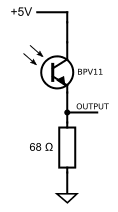
I built up a basic little circuit using a BPV11 phototransistor as the sensor. The output was then read by an oscilloscope and the t.1 interval determined by setting two cursors to correlate to the respective t.1 amplitudes.
The resistor was chosen so that the transistor always operated within linear regions, and collector current was within maximum limits allowed. The device never reaches saturation. It measures light between 620 to 980 nm, peaking at 850nm and has a turn on and turn off response time between 5 to 6 microseconds each (plenty fast enough for our measurements, within 5% for the fastest measurements) (- fixed typo on units, thanks Randy)
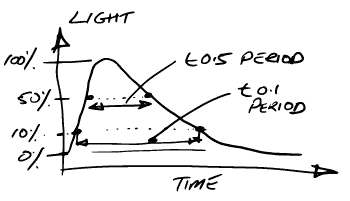
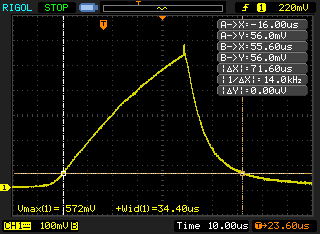
The t.1 (sometimes called t0.1) is measured as below:
Sample Discharges
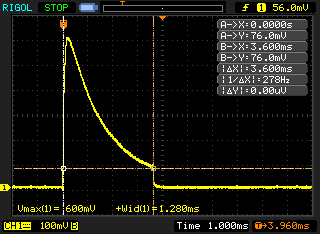
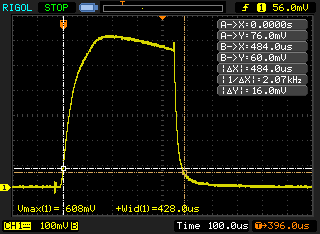
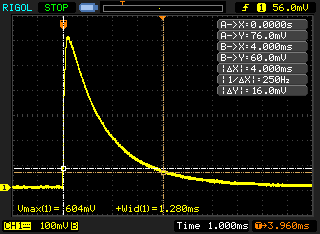
I didn’t bother to save the waveforms for each test, it just would have taken too long. But I did keep a couple for my personal reference. Here are some of them, just as an example to see the shape of light output of the 580EX at different power levels.
The vertical axis is linear to the irradiance at the sensor, so something that is twice as high means it was twice as bright (one stop). From one image to another in the plots below, they are not to scale.
Final Words
This article might be updated later as I get my hands on more gear to test and add to the result list.
Leave a comment if you have any questions, or perhaps you’ve picked up a mistake somewhere.


Thanks for this info Andy! Was trying to research a reference that gave me figures on outputs on various strobes and to find such an awesome resource on the one page was a godsend!
Cheers!
Hi,
I would just like to say a big THANK YOU for all the effort you put in. I’m still confused as to why flash durations are different on every site (I’ve seen sites that say 580ex flash duration is 1/8xx, but also yours), but any input is helpful, albeit confusing.
Many thanks
great work
I enjoyed your writeup. I am considering doing the same and I have a few questions. First, I noticed that the time you measured was off significantly from what the manufacturer states, for example with the Alien Bees/Einstein strobes. What could account for this? I have no doubt the manufacturer would present their product in the best light, but I would also expect you to at least come close to one of their times. I also looked at the specs for the photo transistor you used. I noticed a on-off time stated in microseconds, and you specified nano seconds. Could that be the source of error in your measurements? Also, why not use a photo diode, which I heard is preferred because it is faster? Thanks
Thanks Randy,
I just used parts I had sitting around the shed. Photo diode would have been a little bit better.
I don’t know why the manufacturer has different times, and to be honest, i didn’t really check all of them to compare, i only measured what i could get my hands on.
I did do some research and found most people measure t0.1 and t0.5 based on comparison with the peak intensity based on what i did. This is somewhat deceptive as it doesn’t reflect the amount of lighting coming from the flash, as it does not take into account the flash curve shape, so t0.1 is NOT 90% of the light coming out. The measurement of 90% of the light coming out would involve measuring the area of the curve swept which perhaps might be what some other manufacturers are doing?
But its true that some manufacturer’s don’t tell you how they measure their specs. I should post some links later to those that do for the readers’ reference.
Hello Randy.
The result was amazing. I want to know real flash duration nikon sb28. Its so important data.
I am interested in YN560II type. Its new version of YN560. How is flash duration YN560II?
I think it same. But YN560II has mult flash mode. Is it different condencer?
If you have chance than you use it, I hope please check fulash duration YN560II.
Thank you so much!!
Best regards
Yuki
Thanks Yuki,
I don’t actually have a YN560 II, but if i get my hands on one, I’ll be happy to test it and add it on here!
Regards,
Andy
Hello Andy.
Thank you for your reply. I need fast flash duration for my photo. Becase Im skateboard photographer. The lumedyne action pack is 1/3000 @ 200W(T.1). Its best, but price is expnesive…
If YN560 II is same flash duration as YN560, I will buy four and all flash power are 1/4. Its same flash duration as action pack.
Please do the test when you hage free time.
You are so nice flash master guy!!
Thank you so much!!
Best regards.
Yuki
Andy,
Thanks for the work you’ve done. I was just wondering, can you use the graphs above to calculate the area under the graph and get the total power output in Watt*Seconds for the 580EX? I’m interested in comparing the amount of power to studio strobes, but I can only find hearsay on the internet. For example, “580 EX is 40 w*s at full power” or “580 EX is in the 60-80 w*s range”. But which is correct?!
Thanks again!
Tim
Hi Tim,
Measuring the area under the graph won’t give you the watt-second (Joule) value. Watt seconds (energy) of a flash is usually not calculated by measuring the amount of light emitted, but by the storage capacity of the capacitor which is dumped into the flash tube. Different flash tubes may have different efficiencies, so 600Ws in one brand may likely be different to 600Ws in another.
The best way to measure the watt-seconds of a speedlight is to open up the flash, measure the capacitance of the main capacitor (or capacitor bank), and then measure the terminal voltage when fully recharged. (this is hazardous, don’t try this unless you know what you’re doing)
energy = 0.5 * capacitance * voltage ^ 2
What you’re talking about is lumen-seconds which is actual light output, some manufacturers publish this, some don’t.
Measurement is a little bit more difficult and is more than just measuring a curve under the graph as you need to take into account the shape of the output pattern etc, and working out a way to “measure all the light”.
Andy
Hi Andy,
Thanks for all this work too! I have a simple question, it’s probably really obvious to you.
It’s great tohave the flash duration comparisons. I also need to be able to compare the power output of each flash. I am assuming the poster output/ amount of light is more on an einstein light at 1/128 of its strength than let’s say a speedlight 580Ex at 1/128 it’s strength. Is there a simple way of calculating this? Thanks for your help. Joschi
Hi Joschi,
Thanks for your comments.
I don’t have actual light output comparison from different models of flash units. Its something that could have been measured to some extent but I haven’t done it in the past.
The compare real world usable results, is to just use a light meter with a standard reflector on the unit and compare results that way. Or most manufacturers post guide numbers in their datasheets (with respective modifiers), which can also be used as comparison.
e.g A 580EX speedlight at 105mm zoom has GN 58 while a Einstein 640 with a Retro Laser Reflector has GN 289 which is around 2.5 stops more light. (Ref)
Andy
Thanks for your great work.
The information was very interesting and useful for me.
I wonder you would have information about the flash duration of macro flashes, because my mail work is dental photography (clinic en surgery).
Thank you again.
Thanks Gabriel.
No sorry, I don’t have any information on macro style flashes, simply because I don’t own one or have access to one.
Regards,
Andy
Thanks for the measurements!
Nice to compare these to my own.
I hope you don’t mind that i linked this article on my german Blog.
http://oliverwen.de/blog/index.php?title=abbrenndauer-von-studioblitzen
The Rigol is a widely used model, I think
[...] this study was done a while ago, but the results of the test still reveal interesting information Andy Gock : Newcastle Photographer Actual Measured Flash Durations of Small Speedlight Strobes __________________ Vince "…the law of unintended consequences, sometimes, you get a [...]
[...] 1/250 sec (with the main part being around 1/1000 sec), and much faster at the 1/128 power end (see Andy Gock : Newcastle Photographer Actual Measured Flash Durations of Small Speedlight Strobes). Simply put, the flash pulse duration is usually much shorter than the comparable shutter speed in [...]
Great work Andy, thanks very much for the info. The mind boggles as to why Canon cannot provide this sort of data for their own flashes. Your methods are way over my head but the data is exactly what I needed to know to figure out how much power I can get out of my 580ex II and my Einsteins when married with my fujifilm x100s leaf shutter. Time now to play with killing the sun with flash.
Thanks!
Stefan
Thanks Stefan!